KEB Hana
Bank
Redesign and creation of the internet banking
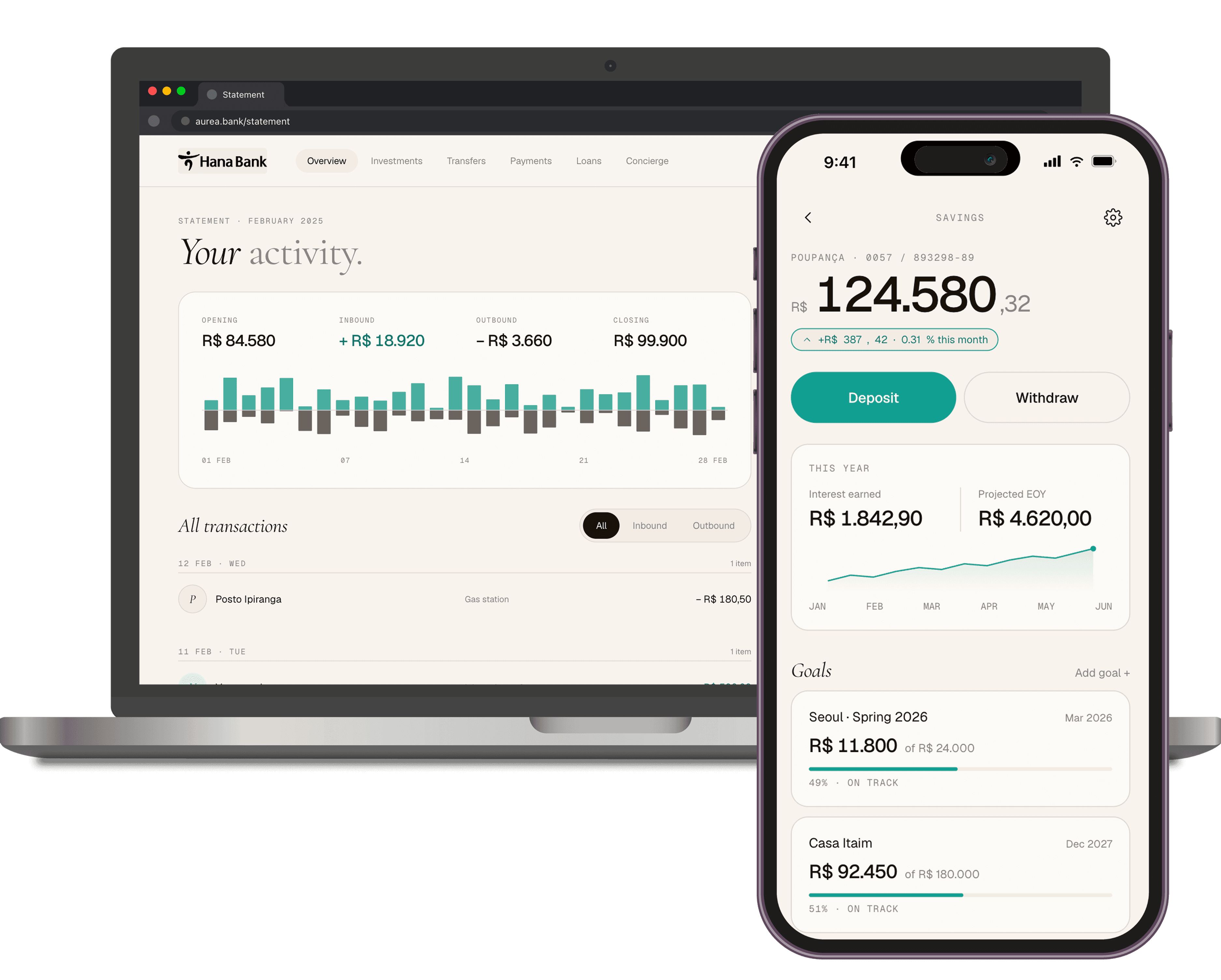
Design and usability simplified in the web and in the app
KEB Hana Bank is one of the largest foreign exchange banks in South Korea. The project focused on redesigning its digital banking experience in Brazil, creating a simpler and more accessible journey for both corporate and individual customers.
Department
Banking
Team structure
UX Designer (me)
Senior UX Designer
Senior UX Research
Project duration
17 weeks/2018
Executive Summary
Situation
KEB Hana Bank wanted to modernize its digital banking experience in Brazil, creating a new web and mobile platform that could support different customer profiles while improving usability and accessibility across digital channels.
Initiative
Working as part of a UX team, I contributed to the redesign process through user research, workshops, usability testing, and interface design. The project involved aligning business goals, customer needs, and technical constraints to create a more intuitive banking experience.
Impact
Increased digital channel adoption from 70% to 90% after launch
Supported the transition to a fully digital banking experience
Contributed to the foundation for future Open Banking initiatives
Product walkthrough
Key design decisions
Simplifying complex financial information
Designing for multiple user profiles
Reducing friction to increase digital adoption
Deep project phases
Research
Ideation
Design
What was done

Start
Learning phase

Research
Learning from people
Analysis
Finding
patterns
Ideation
Generating
Ideias

Prototyping
Defining
scenarios

Validation
Testing and
validating
Learning phase
We started the project by understanding the needs carrying out a CSD matrix (Certainties, doubts and assumptions) with the aim of raising hypotheses about a new solution and solving users' problems. After this survey, we understood that the biggest question we had was regarding the difference between companies and individuals and what specific needs they had.
We soon began to understand the market with a benchmarking survey, in which we were able to identify some points that we took as guidelines for the product, these themes were growing at the time this project was carried out, in 2018.
100% digital and mobile banking
In 2018 there was a huge boom in apps in emerging countries, the boldest banks were completely digital and were the focus of customer demand.
Control
Customizable services, without bureaucracy and without waiting time are on demand. Features such as automatic card blocking and unlocking and instant payments.
Big Data
Access to information on customer consumption habits as a great opportunity to adapt your language and offer targeted products.
Friendly
Fintechs and banks strive to show a human side to their customers. This can be seen in their visual design and also in their relationships with the bank.
Social Bank
Tendency to offer services that put customers in direct contact with each other. Whether it's to pay a bill together at a restaurant or an electricity bill, fundraise for a trip or some other common goal or even offer interest-bearing loans to each other.
Ideation
We carried out 7 initial interviews with user profiles such as support and credit analysts, business and the bank director were approached. In addition to a workshop that brought us more clarity about the product's needs, in total, in total, 9 needs were highlighted, showing the difficulty in working with the particularities of the two different profiles (companies and individuals), the difficulty for the bank to keep up with technological advances, processes that are not automated, doubts of users in operations that lead to excessive use of support, frustration with basic services such as sending receipts, very bureaucratic service and incomplete solutions.
User profile
“Individuals usually have a lower volume of interaction, they pay one or two bills per month. A legal entity, on the other hand, has an absolutely greater volume, often hundreds of invoice payments can be made in one day.”
Technological evolution
“The client asks what processes we are going to automate. Most of our customers have tablets, they want to know if we are going to make the application or usability easier for them.”
User dissatisfaction
“Users need to view and perform their banking transactions and financial services more quickly and conveniently, but currently existing solutions are slow and bureaucratic, generating dissatisfaction with the bank.”
9
needs
found
8
challenges worked on
14
people
involved in the workshop
+200
Ideas
generated
Prototyping
Based on the material generated in the workshop held together with users and stakeholders, we chose to start with low fidelity, as it would bring more creative freedom and faster user feedback when testing for the first time. After making the adjustments, we created the prototype on average and carried out a new round of tests, moving on to the creation of the final design, based on a cyclical design.
Final design
Throughout the research and tests, we realized that the corporate profile was much more complex and required more attention to the needs discovered. For this profile we brought a new login screen in which the user can select the profile related to a specific business account, all records and movements can be seen and related to the profile that performed the action. The fully customizable dashboard became necessary because in addition to having profiles as distinct as companies and individuals, within them users presented specific needs. Statement searches, payment scheduling and multi transactions were also implemented to facilitate the needs presented.
Back to projects